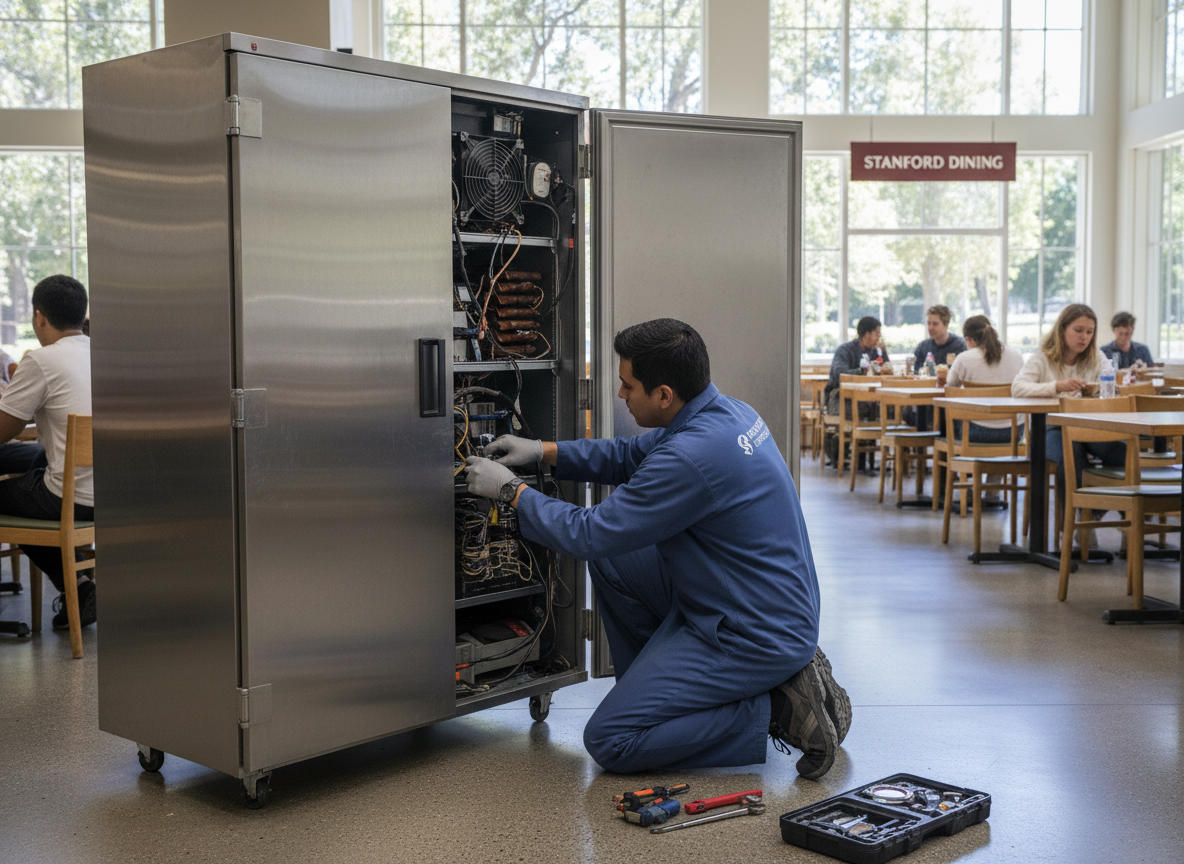
Stanford housing stock near the university campus and Hoover Tower often includes mid-century homes with built-in refrigerators that face unique wear from constant use in mild Mediterranean conditions. These units run year-round without seasonal shutdowns, leading to gradual compressor strain and thermostat drift that homeowners notice as inconsistent cooling in kitchen layouts tucked against older walls. Service calls in Santa Clara County frequently involve accessing tight spaces where original cabinetry restricts airflow, requiring careful panel removal to avoid damaging surrounding finishes.
Proximity to Stanford Stadium and campus events brings higher foot traffic and occasional power fluctuations that affect electronic control boards in newer French-door models. Technicians working routes between Palo Alto and Menlo Park see repeated issues with door gaskets failing from repeated opening during family gatherings, allowing humidity to enter and trigger defrost heater problems. Local soil stability means fewer vibration-related issues than hillside areas, but older wiring in university-adjacent neighborhoods demands extra checks before any high-amp component replacement.
Mild year-round temperatures reduce extreme thermal cycling on condenser coils compared to inland counties, yet dust accumulation from campus landscaping still clogs coils in ground-level units. Repair work here focuses on restoring factory efficiency without overhauling entire systems, preserving the original appliance footprint in compact Stanford kitchens.
Homeowners in these neighborhoods benefit from same-day diagnostics that identify whether a failing ice maker stems from a water inlet valve or a control module, avoiding unnecessary part swaps common in less experienced service approaches.
Technician insight
In Stanford the thing that catches most people out with refrigerator repair is restricted airflow behind built-in units in mid-century homes near the campus; the mild climate keeps the fridge running constantly so coils clog faster than owners expect, and pulling the unit out without damaging the surrounding cabinetry takes extra care.
Built-in unit near Stanford University
A homeowner on campus-adjacent property reported inconsistent temperatures in a 15-year-old built-in refrigerator. Inspection showed a failing defrost sensor and restricted condenser airflow from accumulated dust. Replacement of the sensor and thorough coil cleaning restored stable operation without replacing the compressor.
Refrigerator Repair Services We Offer
✓Compressor Replacement
Restore cooling performance when the compressor fails by installing a compatible unit matched to the model's refrigerant type and capacity.
✓Thermostat Calibration
Adjust or replace the temperature control to eliminate warm spots or over-cooling that wastes energy in Stanford's consistent climate.
✓Door Seal Replacement
Replace worn gaskets to stop cold air leaks that increase run time and cause frost buildup on evaporator coils.
✓Defrost System Repair
Fix heater, timer, or sensor faults that lead to ice accumulation blocking airflow in top-freezer and bottom-freezer models.
✓Ice Maker Repair
Diagnose and repair water supply, mold heater, or harvest issues common in refrigerators serving busy households near campus.
✓Condenser Coil Cleaning
Remove dust and debris from coils to improve efficiency and reduce strain on the compressor in older Stanford homes.
Refrigerator Repair Cost in Stanford, CA
| Service | Typical Range | What Affects It |
|---|---|---|
| Diagnostic visit | $95–$150 | Waived if repair is completed same day |
| Door gasket replacement | $180–$320 | Varies by door size and brand |
| Thermostat or sensor repair | $220–$380 | Includes calibration time |
| Compressor replacement | $650–$950 | Higher for built-in or high-efficiency models |
| Defrost heater or timer | $250–$420 | Depends on access difficulty in older cabinets |
Ranges are typical for Stanford, CA and confirmed with an exact written quote before any work starts.
How it works
- 1
Initial Assessment
Arrive on site and run a full diagnostic on temperature zones, compressor operation, and control board codes while noting the unit's age and installation constraints.
- 2
Component Isolation
Identify the exact failing part through targeted testing rather than guesswork, confirming whether the issue is electrical, mechanical, or airflow related.
- 3
Parts Sourcing
Source OEM or high-quality equivalent components available for common Stanford-area brands and models to minimize downtime.
- 4
Repair Execution
Perform the replacement or adjustment with attention to wiring integrity and cabinet access in tight university-adjacent kitchens.
- 5
Verification
Run the unit through multiple cycles and confirm stable temperatures before leaving the property.
Pricing
Most refrigerator repairs in Stanford fall into mid-range service tiers depending on the component and model age.